A History of Card Holograms
The hologram enters trading cards in 1989 as a security stamp on the back of a base card and exits, eight years later, as a two-million-dollar Michael Jordan. The story is one object learning what it wanted to be.
Sister exhibit: A History of Inserts
The Defensive Era
A hologram on the back, and nobody talking about it
Upper Deck launches its first baseball set in 1989 with a tiny holographic logo stamped on the back of every base card, roughly the size of a fingernail. Its job is not to look cool. Its job is to make the cards hard to counterfeit, because Upper Deck is charging almost twice what Topps charges for a pack and needs a reason to justify the price. Nobody in 1989 is buying Upper Deck for the hologram. This is not the start of the hologram as a collectible object. That is a separate story from a different set of manufacturers, running on different production tech, and it starts next year.
Upper Deck Baseball Back Holograms
Every base card in the 1989 Upper Deck baseball set has a small holographic logo stamped on the back for anti-counterfeit purposes. Not a chase, not a subset. First mainstream use of a hologram in a trading card at any scale.
The Chase Hologram Arrives
Pro Set and Impel, in the same year, from different tech
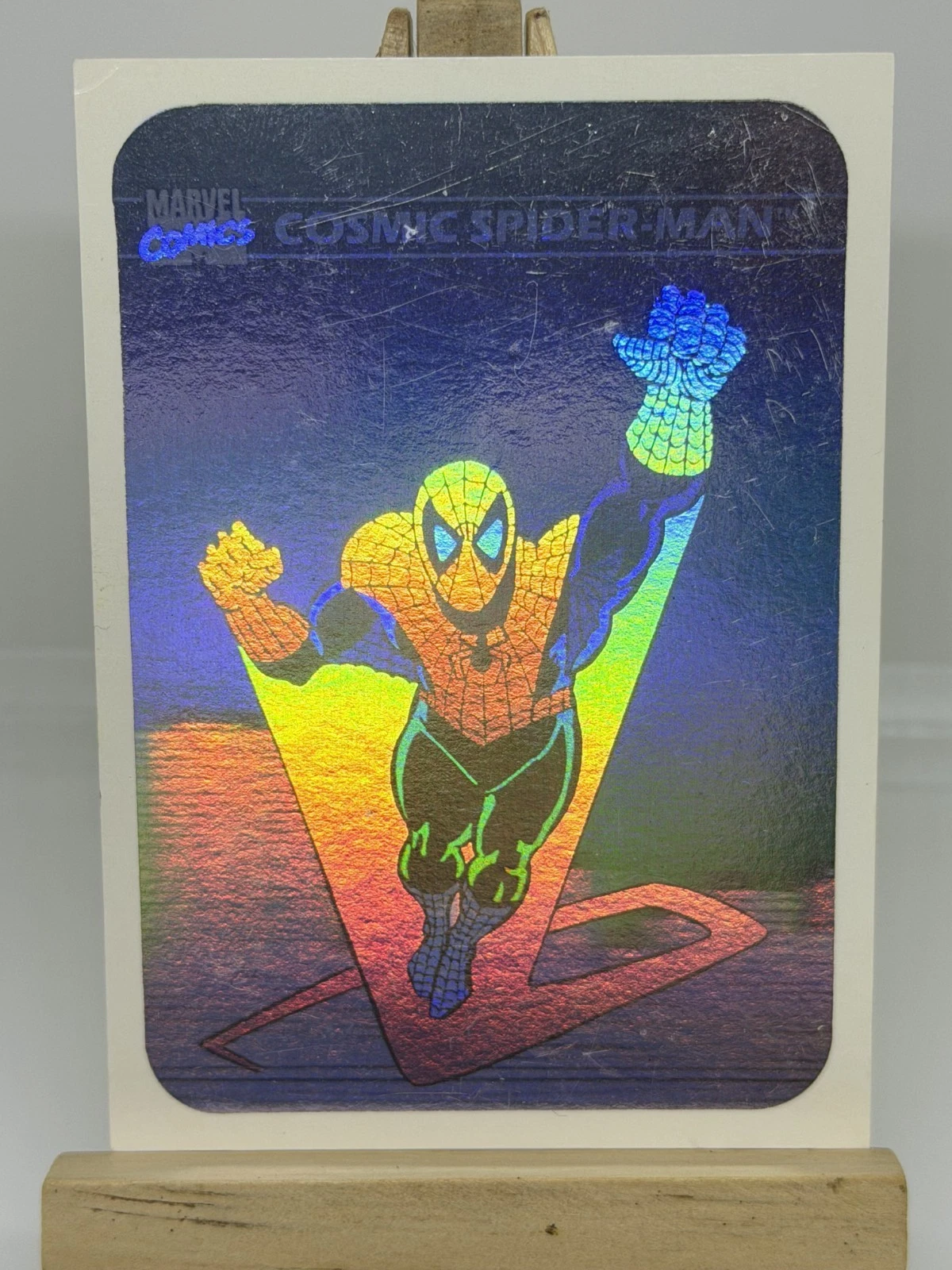
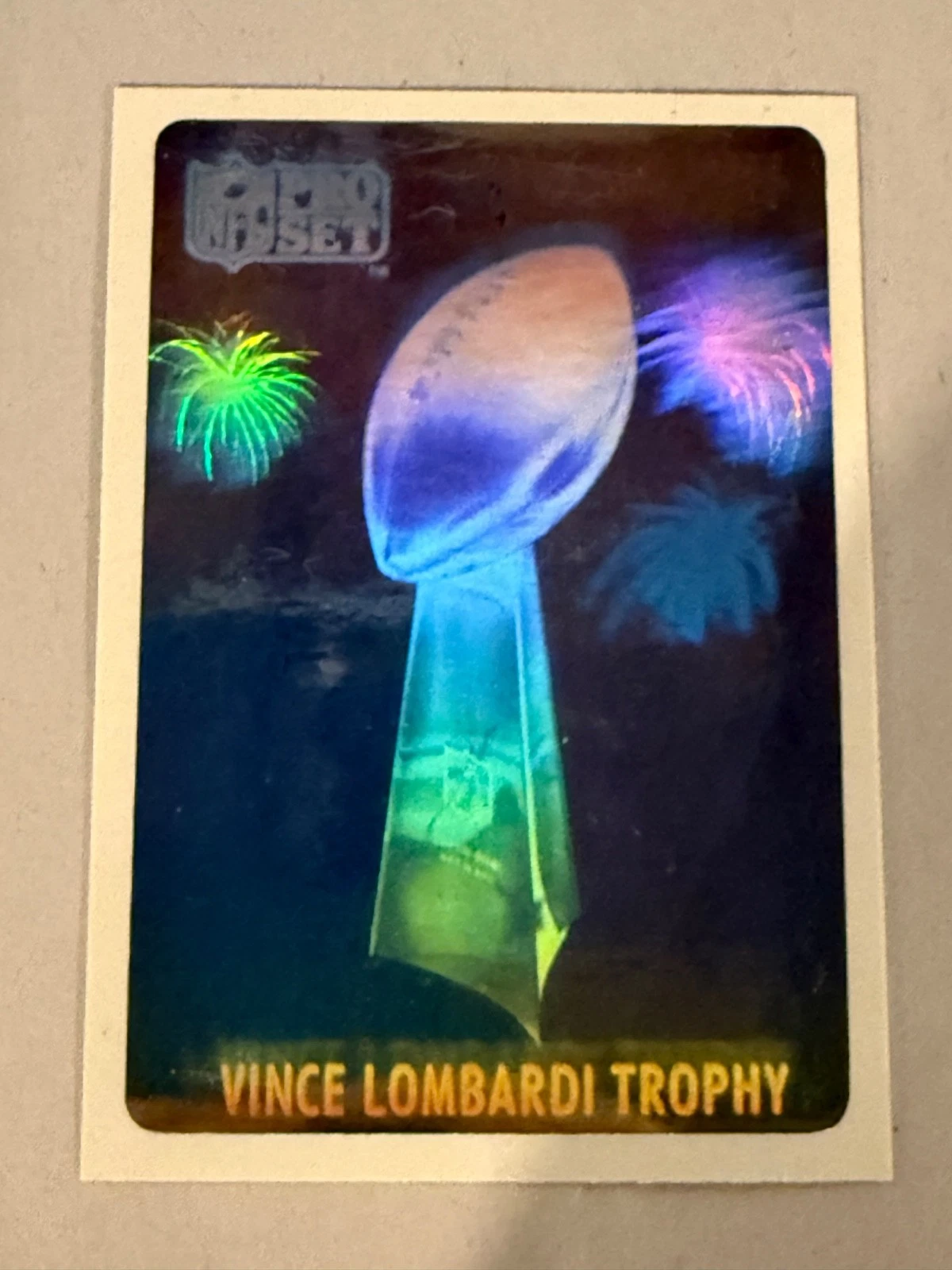
The modern chase hologram arrives in 1990, from two manufacturers that had nothing to do with each other. Pro Set includes a hand-numbered Vince Lombardi Trophy hologram in its 1990 NFL Football set, then follows with the hand-numbered Stanley Cup hologram in its 1990-91 NHL Hockey product. The Stanley Cup is numbered to five thousand copies, on the card, by hand. Later that year, Impel releases Marvel Universe Series 1 with five hologram chase cards seeded at approximately one per box. The Impel holograms were less limited than Pro Set's, so they reached a wider audience. Cosmic Spider-Man MH5 is the one every kid remembers. Between the Stanley Cup at 5,000 copies and the Reggie Jackson AU1 signed and numbered to 2,500 the same year, hand numbering also enters the trading card industry in 1990. Two production paths, two manufacturers, two versions of the same idea landing in eight months. Neither descended from Upper Deck's security hologram. That is a different story with a different chemistry.

The 1991-92 Explosion
Holograms in every premium pack, sports and non-sport
1991 and 1992 are the two years the hologram is the whole product. Impel drops Marvel Universe Series 2 in 1991 with a new run of five holograms, Silver Surfer MH3 among them. Pro Set's Musicards puts hologram chase cards on the biggest bands of the year. Comic Images does X-Men. Skybox's 1992 Marvel Masterpieces takes the format further with Battle Spectra, etched-foil holograms with sculpted layers you can feel with your fingernail. On the sports side, Upper Deck joins the chase-hologram market for the first time with the 1991 Denny's Grand Slam set, twenty-six full-size player holograms distributed through Denny's restaurants, one per team. That is Upper Deck's entry into chase-hologram territory, two years after they had been using security holograms on the backs of base cards. The Baseball Heroes hologram subsets follow in the same window: Hank Aaron #HH1, Ted Williams #HH2, and onward. Also worth naming here, because collectors ask: the 1990 Upper Deck Team Logo Holograms, one per pack, one per team. Not a chase, not premium, a base subset. They belong to a different lineage than the chase cards.
Upper Deck Team Logo Holograms
Twenty-six small square holograms, one per team, one per pack of 1990 Upper Deck baseball. Overproduced. Worth almost nothing today. Named here because collectors always remember them, though they are a base subset, not a chase, and not the product that grew into the modern hologram economy.
Pro Set Musicards & Comic Images X-Men
Hologram chase cards for rock stars and X-Men, seeded through wax at similar rates to the Marvel Series 1 chase. Neither is expensive today. Both taught kids to expect holograms in any pack that was not a sports pack.
How the holograms were made
Holographer Kevin Baumber, quoted by COMC's Chris Mixer: 'I was the holographer responsible for shooting the (original) holograms, not only for Marvel but also various sports cards organizations.' The process began with an original photograph, artwork, or 3-D model. Manufacturers made nickel printing plates and master laser-viewable holograms from that source. Baumber has confirmed the 1991 Marvel Universe Series 2 holograms shifted to hot-stamping foil, a different production path than Series 1.


The Metallic Cross-Pollination
Everything shiny descends from the hologram
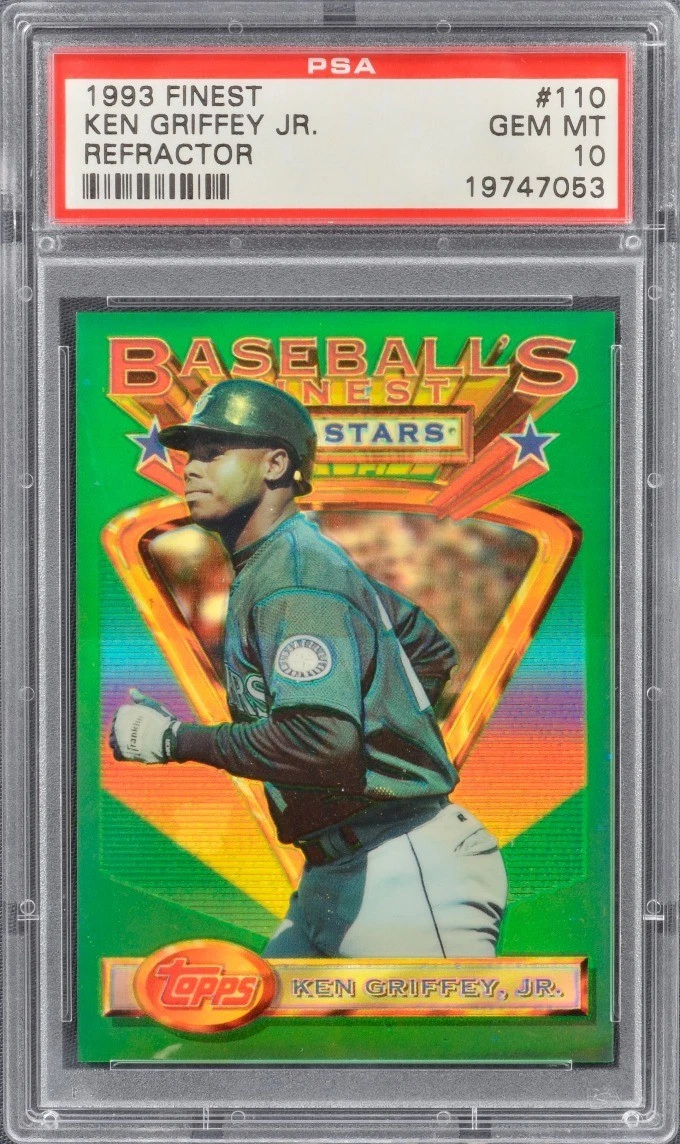
Topps Finest arrives in 1993 with the chromium refractor, which is technically not a hologram but does the same thing to the human eye: shifts color as you tilt it, catches light other cards do not, feels like it costs more than it did. Every premium set for the next four years chases the same visual effect through different materials. SkyBox EX-2000 puts the player photo on transparent acetate with a printed holographic border. Fleer's Metal Universe in 1996 prints entire base cards on foil-textured stock that reads as holographic at arm's length. And Upper Deck ships SPx in 1996-97, an entire set of die-cut hologram-hybrid cards, with SPx Gold parallels signed and numbered to twenty-three copies. The 1996 SPx Gold Jordan #8 signed /23 has sold at auction for $15,123. The hologram stopped being a specific manufacturing technique and became a category: any card that catches light in a way base cards do not. Chris Carlin, longtime Upper Deck executive (1998-2022), later said the tech was 'insanely expensive and still is today,' which is why Upper Deck stopped shipping full hologram sets after 1998.
SkyBox EX-2000 Acetate
Transparent acetate cards with the player photo suspended in a holographic border. The technology was expensive and the print runs were small. EX-2000 rookie cards in high grade are quietly some of the most under-valued premium cards of the mid-90s.
Fleer Metal Universe (base)
Entire base set printed on foil-textured stock with painted comic-style artwork. Not technically holographic but reads as holographic in hand. Sets the visual language the 1997-98 PMG parallel would push to the limit.

The Endgame
Precious Metal Gems, and the card as pure light
1997-98 Metal Universe Championship ships with a parallel called Precious Metal Gems. Green PMGs are numbered to 100 copies per player. Red PMGs are numbered to 10. Each card is a full holographic gem-cut printing of a base card, and the print run is engineered to be tiny at manufacture. Michael Jordan's PMG Red #23 is one of ten copies of that card that will ever exist. It has sold at auction for over $2 million. The Kobe Bryant PMG Red rookie is one of the most valuable modern cards ever printed. Everything from Panini Prizm to Bowman Chrome Auto Superfractor 1/1 runs on the mechanic PMG proved out in 1997: holograph plus print run plus registry plus time equals asset class. This is where the material history of the trading card hologram ends and the financial history begins.
Precious Metal Gems (PMG)
Green PMG: 100 copies per player. Red PMG: 10 copies per player. Every card in the base Metal Universe Championship set has both parallels somewhere in the print run. Kobe Bryant PMG Red rookie has sold above $2 million. Jordan PMG Red #23 has done the same. This is where the modern parallel arms race ends.

The hologram walked into cards as a security feature and walked out as an asset class. Everything shiny that lands in a pack today, refractor, prizm, optic, superfractor, is the same idea Upper Deck stamped on the back of a Nolan Ryan in 1989.
- Chris Mixer, "The Rise and Fall of Hologram Trading Cards", COMC Blog, February 2024. Production-side history including Kevin Baumber and Chris Carlin quotes cited above.
- Kevin Baumber, holographer, on his own Facebook posts (quoted by Mixer): described nickel printing plates, master laser holograms, and the shift to hot-stamping foil for 1991 Marvel Universe Series 2.
- Chris Carlin, former Upper Deck Head of Customer Experience (1998-2022), 2018 industry interview (quoted by Mixer): "There were issues getting scans of the players and the (hologram) technology was insanely expensive and still is today."