What to Do With Your Old Junk Wax Baseball Cards
You found the shoebox. Here is the honest version of what happens next.
The hard truth
Someone somewhere is about to be disappointed, and we would rather it be us than a stranger with a lowball offer. So here it is up front: the vast majority of the cards in that box are worth pennies. Between 1986 and 1993, during what the hobby now calls the junk wax era, the card companies printed billions of cards a year. Then everyone did exactly what you did. They saved them. Sleeved them, boxed them, tucked them in the attic for the payday that was surely coming. Supply that enormous, meeting a generation of collectors who all held on, crushed demand flat and never let it up.
That is the part the late-night infomercials never mention. A 1989 Donruss rack pack you kept sealed for decades, the one that felt like buried treasure? It is worth about three dollars. A run-of-the-mill common from 1990 Topps or 1991 Fleer sells for a cent or two, if it sells at all. This is not a knock on your cards. It is arithmetic. The good news, and there is some, is that a handful of cards from these years are genuinely valuable, and it costs nothing to check.
The exceptions that matter
Value in junk wax comes from one formula: a Hall of Fame name meeting real scarcity, whether that scarcity is an error, a short print, a premium issue, or a card that almost never survived in perfect shape. These are the cards worth pulling out and looking at closely. Check the year, the set, and the card number, because a small difference in any of those can mean a large difference in value.
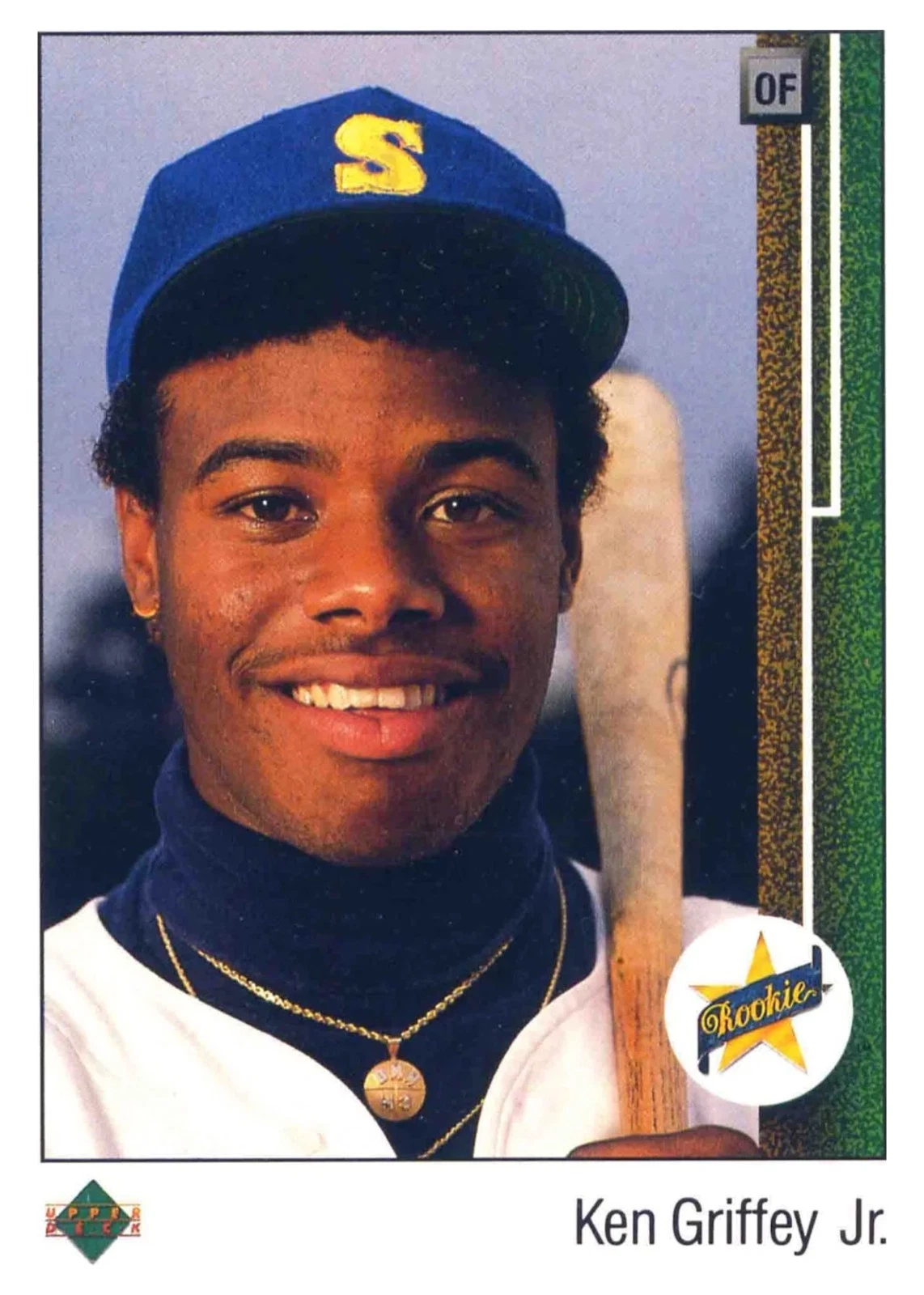 1989 Upper Deck Ken Griffey Jr. #1. The card that opened
Upper Deck's first set and became the face of the whole era. A clean raw copy runs about
30 to 50 dollars, and a flawless
PSA 10 has reached around 5,400.
Look for sharp corners and clean white borders, which are hard to find on a card this
heavily printed. See recent sales on eBay.
1989 Upper Deck Ken Griffey Jr. #1. The card that opened
Upper Deck's first set and became the face of the whole era. A clean raw copy runs about
30 to 50 dollars, and a flawless
PSA 10 has reached around 5,400.
Look for sharp corners and clean white borders, which are hard to find on a card this
heavily printed. See recent sales on eBay.
1986 Fleer Michael Jordan #57. Not baseball, but if it turns up in a shoebox it changes your whole day. This is the crown jewel of the era's neighboring years. Even a well-worn raw copy clears 3,000 dollars, and a PSA 10 sells for north of 300,000. Beware counterfeits, which are everywhere. Compare listings on eBay.

1993 SP Derek Jeter #279. Be precise here, because it is the foilboard SP card, not the far more common 1993 Topps Jeter. The SP is printed on a fragile foil stock that chips at the slightest touch, which makes a clean copy genuinely rare and drives high grades into the tens of thousands. Our JW50 pages document the SP Jeter in full. Look it up on eBay.


If none of these are in your box, that is normal and expected. Most boxes hold none of them. For the fuller lists, our guides to the most valuable 80s cards and most valuable 90s cards carry live pricing, and the visual guide walks through how the whole era rose and fell.
Should I grade this?
Grading is where hope goes to spend money. A PSA submission runs roughly 25 dollars a card at the cheapest tier and climbs past 100 for faster service or higher-value cards, and you pay per card whether it comes back a 10 or a 6. So the question is never "could this grade well," it is "does the graded price beat the raw price plus the fee by enough to bother."
The math is simple once you frame it that way. If the raw card is worth 20 dollars and a PSA 10 sells for 200, and you look at it under good light and genuinely believe it could grade a 10, then maybe. Even then, a 9 instead of a 10 can wipe out the gain, so pristine means pristine: perfect centering, sharp corners, clean edges, no print lines. If the raw card is worth two dollars, the answer is never. No grade a common can earn will clear the fee.
Selling paths, ranked by effort and return
A lot sale on Facebook Marketplace or OfferUp. Sell the whole shoebox for one price, usually 20 to 50 dollars. Least effort, fastest cash, no sorting. This is the right answer for most boxes of commons.
eBay, individual listings. Worth it only for iconic cards. Fees eat roughly 15 percent and listing takes real time, so this pays off only when a single card clears enough to justify the work. Take clear, well-lit photos of the front and back. Browse comparable junk wax lots on eBay to see what buyers actually pay.
A local card shop. Bring your stars, not your commons. Expect roughly 10 to 50 cents per card for anything worth buying, because the shop has to resell at a margin to stay open. It is fast and it is honest, and it will feel low, because it is the wholesale price.
A card show or hobby convention. Dealers there make lot offers on the spot and are set up to move bulk. Good for clearing quantity in an afternoon, and you can walk the tables to gauge offers before you sell.
Consignment through COMC or PWCC. These services list and sell on your behalf, but they are built for high-value graded cards and take their cut. Not worth it for commons, and not worth it for anything raw and inexpensive.
Donation. The Salvation Army, Goodwill, and local thrift stores will take the box, and a donation may qualify for a modest tax deduction. Sometimes the cleanest exit is the one that helps someone else and clears your closet.
What to avoid
Where there is hope, there are people ready to sell it back to you. Be wary of "we buy your collection" mail-in services, which quote high and pay low once your cards are in their hands. Be warier still of the friendly stranger in a Facebook group who offers to "take it off your hands," then quietly cherrypicks the two cards that were worth anything before passing the rest along. And never ship first and get paid later. Anyone who insists on that is telling you how it ends. If a card is genuinely valuable, sell it somewhere with buyer and seller protections, and photograph everything before it leaves your hands.
The last option
Keep the shoebox. We mean that. After you have checked for the errors and the star rookies, after you have done the honest math on grading, you may find the whole collection is worth twelve dollars at a lot sale, which is not worth the afternoon it takes to photograph and list and haggle. But the box is worth something the market cannot price. That 1987 Topps set, the one with the wood-grain borders, is worth more as a conversation piece on a shelf than as a sale.
These cards are artifacts of a specific cultural moment, a stretch of years when a whole generation believed cardboard would pay for college. It did not, and that is part of the story too. Someday you will open this box with your kids, or a friend who remembers the same bike rides to the same drugstore counter, and the memory dividend will beat the twelve dollars every time. Sometimes the best return on a collection is the story you get to tell about it.
Frequently asked questions
Are 90s baseball cards worth anything? +
Most of them are worth pennies. Card companies printed billions of cards between 1986 and 1993, and almost everyone saved them in perfect condition, so supply overwhelmed demand and never recovered. A typical early 90s common sells for a cent or two, and a whole shoebox usually trades as a single lot for twenty to fifty dollars. The exceptions are a short list of star rookies, printing errors, and premium foil cards. If you have a 1993 SP Derek Jeter, a 1990 Topps Frank Thomas No Name on Front error, or a clean 1989 Upper Deck Ken Griffey Jr., those are worth real money. Nearly everything else is worth the memory, not the sale.
Should I get my cards graded? +
Only for a short list of iconic cards in visually pristine condition. Grading costs roughly 25 to 100 dollars per card depending on the service tier and turnaround, so the math only works when the graded price clears the raw price plus that fee by a wide margin. If a raw card is worth 20 dollars and a flawless PSA 10 sells for 200, and you genuinely think it could grade a 10, it may be worth submitting. If the raw card is worth two dollars, grading it will always cost more than the card will ever be worth. When in doubt, look up recent sold prices for both the raw and the PSA 10 version before you spend anything.
Where can I sell old baseball cards? +
The fastest option is a lot sale on Facebook Marketplace or OfferUp, where you sell the whole shoebox for one flat price with almost no effort. For individual iconic cards, eBay reaches the most buyers, though fees take roughly 15 percent and good photos matter. A local card shop will buy your stars for pennies to a few dozen cents each because they need resale margin. Card shows and hobby conventions are good for moving bulk to dealers. For high-value graded cards, consignment through COMC or PWCC can make sense, but it is not worth the effort for commons.
What junk wax cards are worth money? +
A small, specific set of them. The headliners are the 1989 Upper Deck Ken Griffey Jr. rookie, the 1986 Fleer Michael Jordan, the 1990 Topps Frank Thomas No Name on Front error, the 1993 SP Derek Jeter, the 1989 Fleer Bill Ripken profanity error, the 1990 Leaf Frank Thomas rookie, and the 1989 Upper Deck Dale Murphy reverse negative. Beyond those, value comes down to a Hall of Fame name meeting genuine scarcity, whether that scarcity is an error, a short print, a premium foil issue, or a pristine high grade of an otherwise common card.
What should I do with a box of old baseball cards I found? +
Check it against a short list of valuable cards first, then decide. Pull anything that matches a known star rookie or a famous error and look up its recent sold prices. If you find a genuine iconic card in clean condition, it may be worth grading or listing individually. If you find only commons, which is by far the most likely outcome, your realistic choices are a lot sale, a donation for a possible tax deduction, or simply keeping the box. For most people the box is worth more as a keepsake than as a sale, and there is no shame in choosing that.