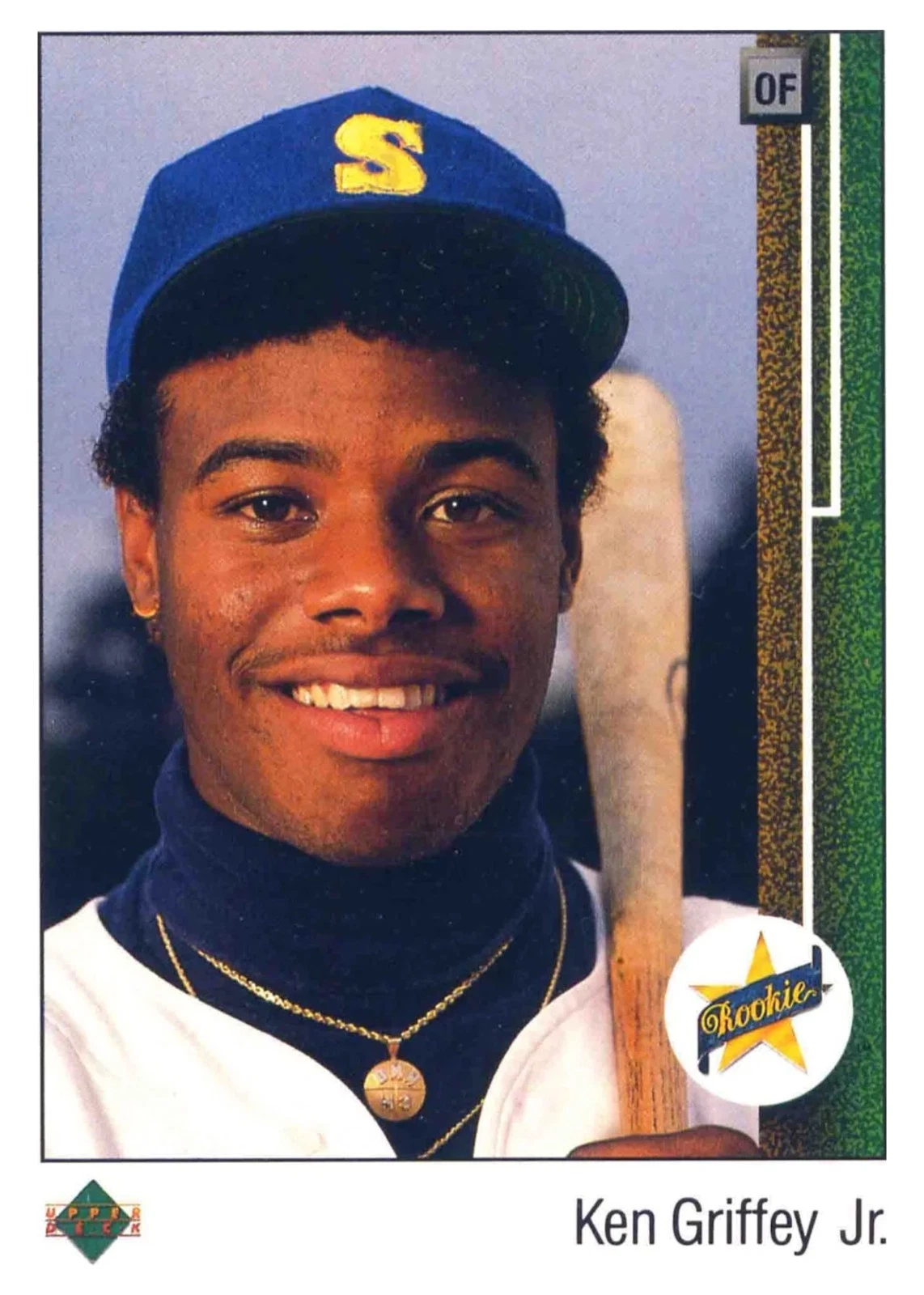
1989 Upper Deck #1 Ken Griffey Jr. (front)
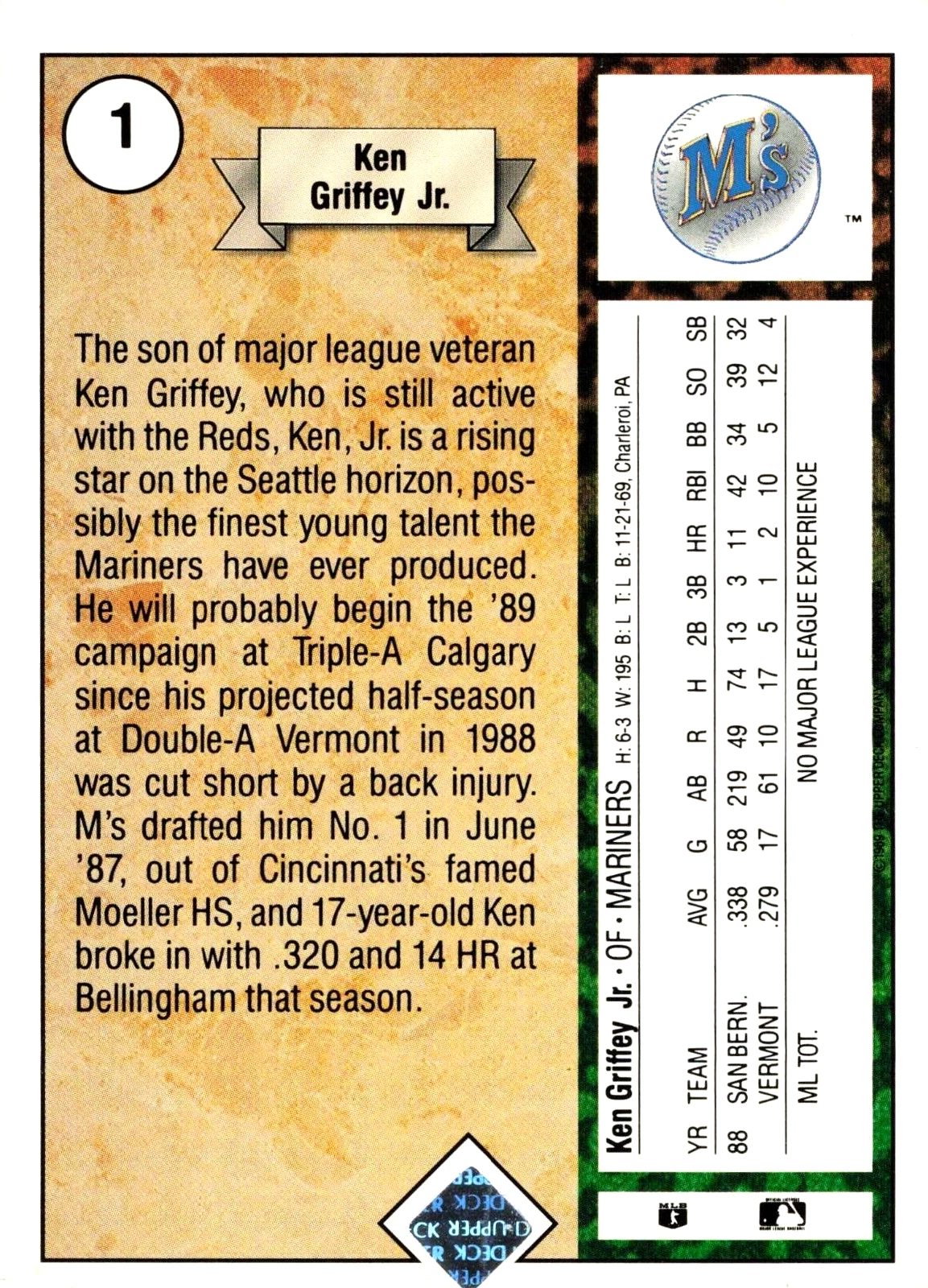
1989 Upper Deck #1 Ken Griffey Jr. (back)
View current eBay listings →

Affiliate link. As an eBay Partner, Junk Wax Museum may earn from qualifying purchases at no additional cost to you. Opens in a new tab.

#1
The Griffey Phenomenon

Ken Griffey Jr.

1989 · Upper Deck · #1
Overall rank
#1 of 50
Year
1989
Brand
Upper Deck
Card #
1
Sport
baseball
Card type
rookie
Wanted Instantly remembered
Raw
$107
$102 - $112
conf A · n=7
PSA 8
$387
$355 - $418
PSA 9
$434
$414 - $454
conf A · n=7
PSA 10
$5,400
$5,114 - $5,686
conf A · n=3
Fair Market Value · 7-day winsorized median · as of 2026-07-21
Price history

Population Report

Grading census
Total graded
133,505
PSA graded only
PSA 10 population
4,371
3.8% overall gem rate
Grade distribution · PSA 1 to 10 (all graders)
Grade 10
4,371
Grade 9
34,616
Grade 8
47,866
Grade 7
16,547
Grade 6
14,917
Grade 5
7,964
Grade 4
3,002
Grade 3
994
Grade 2
393
Grade 1
398

Why It Belongs

This is the card that built the modern baseball hobby. Upper Deck walked into 1989 as an unknown and put a teenager who hadn't played a big-league game at the #1 slot. The gamble paid off so completely that "Upper Deck #1" became shorthand for an entire era. It belongs here as the set anchor and the emotional center of the Griffey phenomenon. Every collector who came up in the late 80s and early 90s measures the hobby against this card. It's overproduced, it's cheap raw, and it still matters more than cards worth fifty times as much.

What Every Kid Remembered

This was the one you wanted. Not because it was rare, but because it was cool. The white border, the clean photo of Griffey in the Mariners cap with that grin, the hologram on the back that felt like technology from the future. Kids flipped the card over just to tilt the hologram in the light. If you pulled it from a pack you felt rich, even though half your friends had one too. It was the card you protected in a top-loader while your commons rode loose in a shoebox. Griffey was the guy everybody agreed on.

The Hobby Story

Upper Deck launched in 1989 with tighter print runs than the competition, tamper-proof foil packs, and a hologram on the back to fight the counterfeiting that plagued Topps and Fleer. Giving card #1 to a 19-year-old was pure marketing swagger, and it required Upper Deck to solve a problem no one talks about: they did not have a licensed Major League photograph of him. Griffey had never played an MLB game. The photo used on the front is actually a shot from his 1988 Class A season with the San Bernardino Spirits in the California League, altered on a Scitex graphics workstation (the pre-Photoshop industrial system that cost hundreds of thousands of dollars per seat and was the standard for high-end image editing in the late 80s). Upper Deck's production team stripped the Mariners logo in over the Spirits cap, tinted the jersey color, and cropped the image tightly so the mismatched jersey trim would not read on a small card. Griffey himself has publicly confirmed the story, pointing out to The Sporting News in 2014 that the jersey is missing the blue stripe that would appear on a real Mariners uniform and that the hat trim is not quite right. The original Polaroid from the photo session later sold at auction for nearly $14,000. The card hit $20 by late 1990 and pushed past $300 at its peak before the junk-wax reality set in: Upper Deck still printed millions. Today a raw NM copy trades for $15-40 all day. PSA 10s sit around $2,500-3,500 because gem-mint centering is genuinely tough on this card. It remains the definitive junk-wax rookie, and the fact that its founding image is a digitally-altered minor league photograph only adds to the legend.

Versions & Variations

One base version, no official parallels. The card's fame spawned a cottage industry of counterfeits, some good enough to fool a casual buyer. Centering and the notorious print snow (tiny white specks in the border) separate a PSA 10 from a PSA 8. There's no error variation on the #1, but collectors chasing the full 1989 Griffey rookie run pair it with the Fleer, Donruss, Bowman, Score Traded, and Topps Traded. The hologram back is the built-in authentication feature, and it's the first thing to check on any questionable copy.

How to Identify It

Card #1, front shows Griffey in a Mariners cap and jersey (though the cap logo and jersey were Scitex-altered from a San Bernardino Spirits minor league photo, and close inspection reveals the missing blue Mariners jersey stripe and slightly off hat trim that Griffey himself has pointed out), white border with thin team-color stripes and the Upper Deck logo top-right. The back carries the small diamond hologram, a second photo, and stats on a light background. Genuine holograms shift cleanly between the baseball diamond image and the UD logo when tilted. Fakes show flat, printed-on "holograms," blurry back photos, or borders whiter than the slightly cream original stock. The card number sits inside the design on the reverse.

Also Considered

Other cards that competed for this slot in the JW50, and why they didn't make the cut.

1989 Donruss Ken Griffey Jr. #33 (Rated Rookie)
1989 Donruss Ken Griffey Jr. #33
Search on eBay →
Rated Rookie

The Rated Rookie logo made this the second Griffey collectors chased in 1989, and it's still the pick for people who prefer the classic Donruss subset. It loses the slot because Upper Deck #1 defined the launch of an entire era, while this one was one Griffey rookie among many. A cleaner design than Donruss usually delivered in the junk-wax years, but it never carried the same cultural weight.

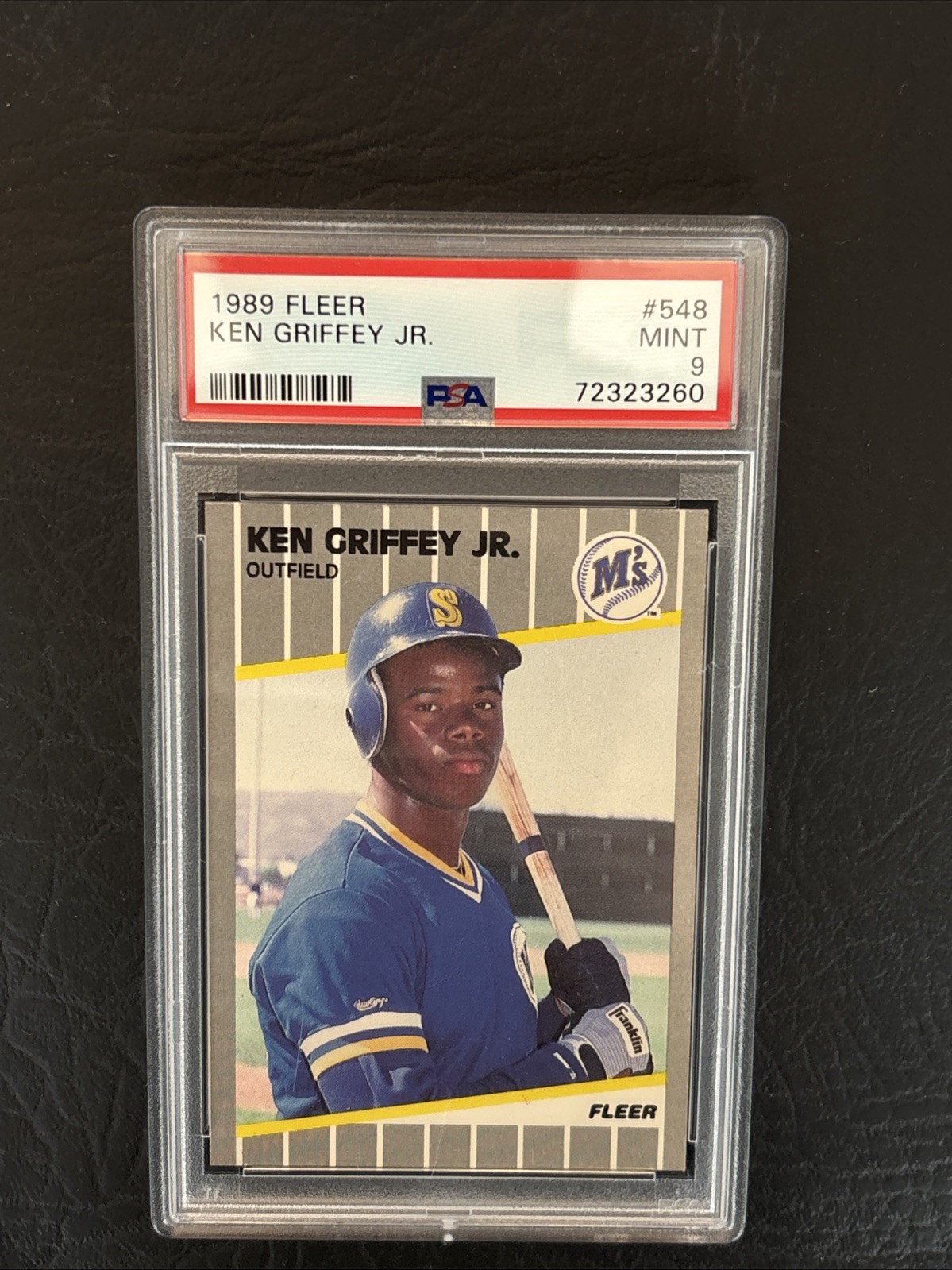
1989 Fleer Ken Griffey Jr. #548
Search on eBay →

Fleer's Griffey is the sneaky-good one: sharp photo, gray borders that show wear less than most 1989 sets, and a genuinely undervalued piece of the rookie run. It loses the slot on ubiquity and lack of narrative. Upper Deck #1 has a story, this card is just a good rookie in a stacked year.

1989 Bowman Ken Griffey Jr. #220
Search on eBay →

Bowman's oversized-format 1989 return put Griffey on the checklist, and the card is a fun curio for the odd dimensions alone. It loses the slot because the format never caught on and the card sits well below the Upper Deck, Donruss, and Fleer copies in collector demand. A footnote in the Griffey rookie run, not a headliner.