Affiliate link. As an eBay Partner, Junk Wax Museum may earn from qualifying purchases at no additional cost to you. Opens in a new tab.


Affiliate link. As an eBay Partner, Junk Wax Museum may earn from qualifying purchases at no additional cost to you. Opens in a new tab.
The 1990 Topps Frank Thomas No Name On Front is the most valuable and most-storied error card of the entire junk-wax era, and a legitimate Mount Rushmore candidate for the museum. A small early press run of card #414 went out without Thomas's name printed at the bottom banner. Topps caught the error and corrected the plate, but the mistake made it into packs. The NNOF became the era's white whale: a rookie card of a Triple Crown-tier slugger, missing the exact print detail that identifies him. It made adults rip cases of 1990 Topps in 1994 hunting for a life-changing pull, and it's still the card people rip for today. PSA 10s trade in the $30,000+ range; even beat-up raw copies clear four figures on any given weekend.
You checked every single Frank Thomas in your box. If the name wasn't there, you had one. Every kid heard the rumor from someone, usually the counter guy at the card shop, who said his cousin's friend pulled one out of a rack pack at Kroger. Ninety-nine percent of collectors never saw a real NNOF in person, which is exactly why it stuck in memory. It was the boogeyman of 1990 Topps: the one that could actually be in your stack, if you'd just look one more time.
The NNOF slipped past Topps quality control in an early press run and was corrected within weeks, meaning the overwhelming majority of 1990 Topps #414s carry Thomas's name at the bottom as intended. Beckett formalized the price gap in 1991 and by 1993 the NNOF was already trading in the low four figures raw. Frank Thomas's Hall-of-Fame trajectory kept the demand curve steep even during the mid-90s hobby crash. The PSA population report shows fewer than 100 PSA 10s and roughly 1,500 total submissions, remarkable rarity for a mainstream Topps set that otherwise produced hundreds of thousands of graded rookies. It is the single most valuable chase card the junk-wax era produced by accident.
Two versions of #414 exist: the NNOF (no player nameplate lettering on the front) and the corrected base card (Thomas's name printed in the bottom banner as normal). Both use the same photo and the same back. There is no legitimate autographed parallel from Topps in 1990. The most common fake on the market is a chemically or mechanically altered corrected card where the printed name has been removed, look for ghosting, faint lettering shadows, disturbed gloss, or fibers pulled off the cardstock where the letters used to be. A genuine NNOF has a completely clean banner, undisturbed print surface, and the same gloss as the rest of the front.
Vertical portrait of Thomas in his White Sox home whites, batting-practice photo, with 'WHITE SOX' and the position line across the top. On a normal 1990 Topps card the bottom carries the player's name in the colored banner. On the NNOF that banner is present but blank, no lettering, no shadow, no ghosting where the name should be. Back of card is identical to the corrected version: standard #414, position 1B, White Sox, biographical block. Any card with faint traces of removed lettering, surface disturbance in the nameplate area, or a slightly different gloss on the bottom banner is not a legitimate NNOF.
Other cards that competed for this slot in the JW50, and why they didn't make the cut.
The corrected version of the same card, with Thomas's name printed in the bottom banner as Topps intended. Cheap, common, and sitting in every 1990 Topps stack. It loses the slot because the museum entry is the accident, not the fix. The NNOF is the story; the corrected #414 is what happens after quality control catches up.
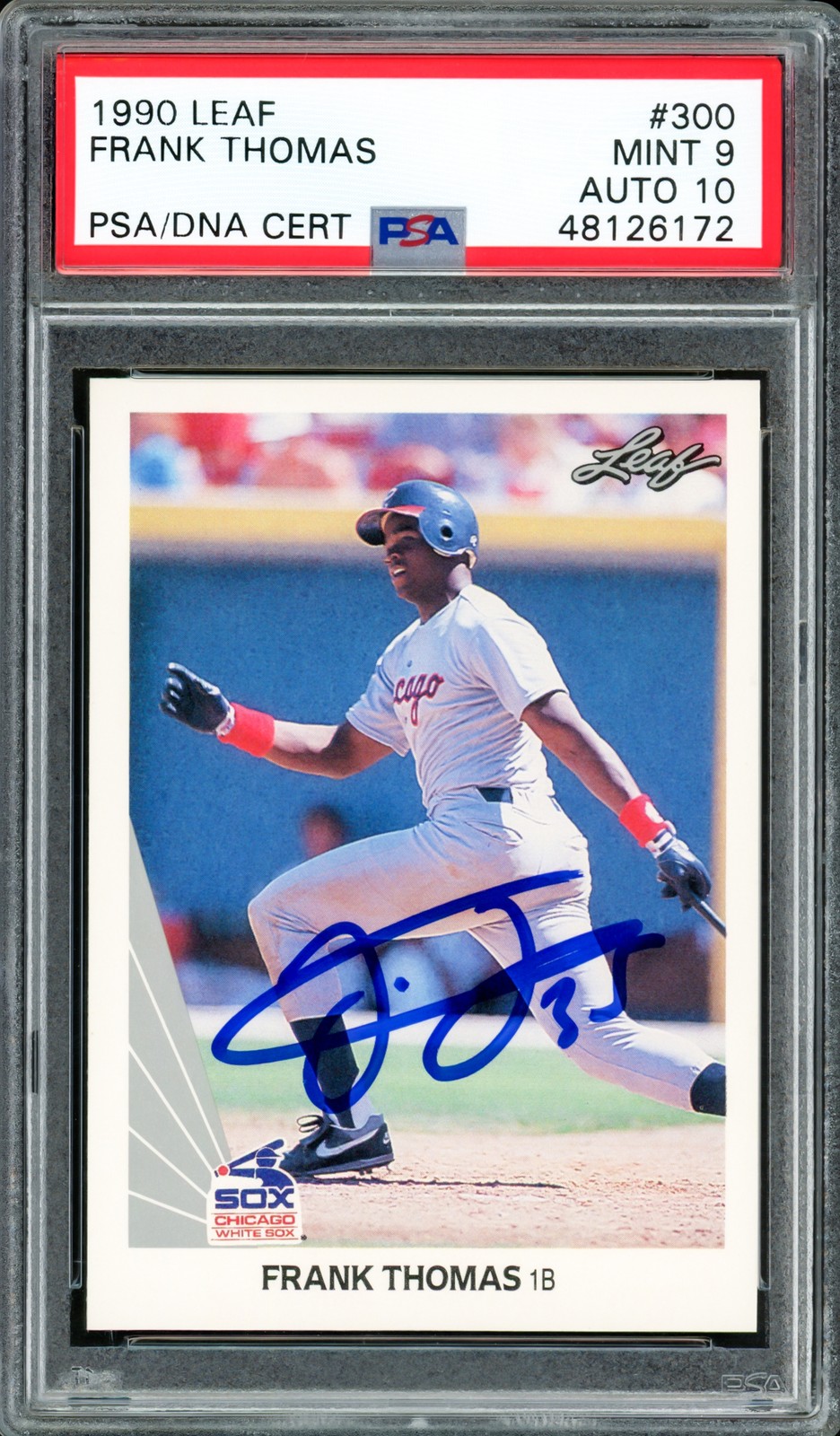
The Big Hurt's premium Leaf rookie, which also made the museum at rank 18. Better-looking card by a mile, real Hall of Fame résumé holding up the price. It shares a slot in the museum with the NNOF because they tell different halves of the same story: this one is the design-and-player argument, the NNOF is the accident-and-scarcity argument.