1993 SP Derek Jeter #279
The card where the junk wax era ends and the modern hobby begins.
Published July 19, 2026
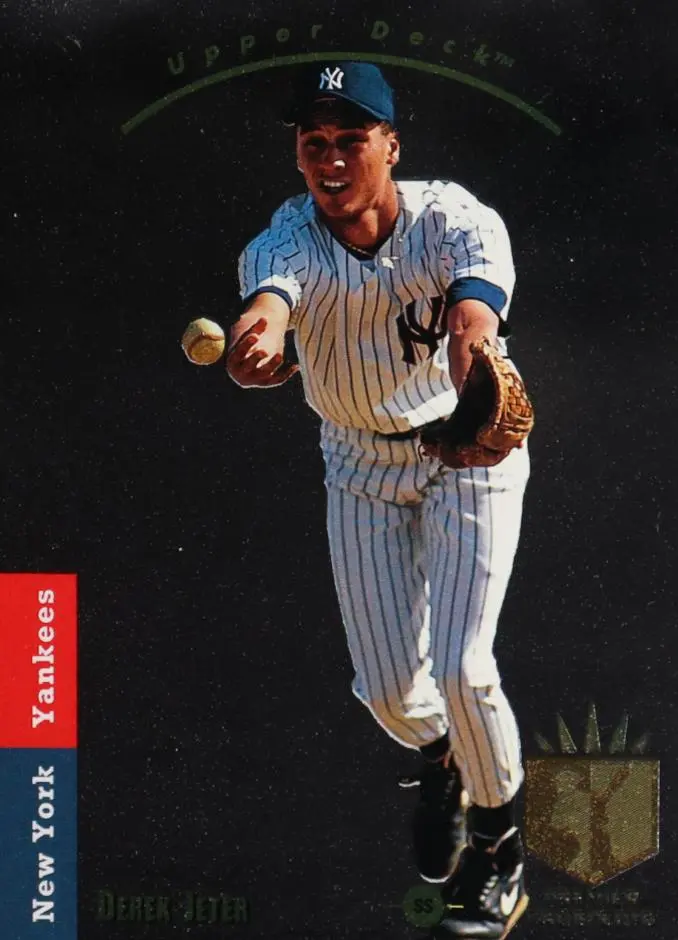
This card sits outside the JW50 on purpose. It is the boundary marker, the exact point where overproduction ended and the premium chase era began. The museum keeps it here as the line, not as one of the fifty cards inside it.
Affiliate link. As an eBay Partner, Junk Wax Museum may earn from qualifying purchases at no additional cost to you. Opens in a new tab.
Every era needs a card that marks where it stops. For the junk wax era, that card is the 1993 SP Derek Jeter #279. It arrived the same spring as the mass-produced 1993 Topps Jeter #98, the last honest flagship rookie of the overproduction years, but it belonged to a different world entirely. Where the Topps was printed by the millions on plain white cardstock and shipped to every gas station in America, the SP was a reflective foilboard short print engineered to be hard to find. One of these cards closed the junk wax era. The other opened everything that came after it. This page is about the one that opened it.
Why this card is the boundary
The junk wax era was defined by a single idea taken to its breaking point: print as much as the presses will allow. From 1987 through 1993, every manufacturer flooded the market with cardboard, convinced that the next rookie would repeat the miracle of the 1986 Fleer Jordan. It never did, because everyone was doing it at once. By 1993 the hobby was drowning in its own output, and collectors had learned the hard way that a card printed a billion times is a card worth almost nothing.
Upper Deck's SP set answered that problem by inverting it. Instead of printing more, it engineered scarcity back in on purpose. The 1993 SP baseball release wrapped its premium Foil subset cards, Jeter's #279 among them, in a reflective foilboard stock that looked and felt nothing like a wax-pack common. The message was unmistakable: this is not the disposable cardboard your shoebox is full of. This is a chase card, and you were lucky to pull it. That shift, from volume to scarcity, from disposable to premium, is the entire dividing line of the modern hobby, and the Jeter #279 is the card that carries it.
The foilboard stock
The physical card is the argument. The SP Foil subset was printed on a mirror-like foilboard that caught the light and shifted color as you tilted it, a deliberate break from the flat, uncoated stock that had defined the decade. It felt heavier and slicker in the hand, and it announced its own value the moment you saw it in a pack. Foilboard was the visual language of the coming era, and premium sets spent the next several years chasing that same reflective look with foil, refractors, and holograms.
That same stock is also why the card became a grading nightmare in the best possible way for its value. Foilboard chips at the edges the instant it rubs against another card, and the reflective surface shows every fingerprint and print line. Cards pulled from packs and dropped into a stack, exactly the way kids had always handled cardboard, arrived at grading companies with chipped corners and scuffed surfaces. The stock that made the card feel premium also made a genuine gem-mint copy genuinely rare, and that scarcity is now baked into the price.
Limited print run mentality
The 1993 SP set was not truly rare in the way a 1950s issue is rare. It was printed in real quantities. What changed was the mentality behind it. For the first time, a mainstream set was built around the premise that not every card should be easy to get. The Foil subset was a short print inside the set, a card you chased rather than expected, and that framing was brand new to a generation of collectors who had spent a decade opening packs where everything was common.
This limited-run thinking is the seed of everything that followed: serial numbering, insert ratios, parallels, and hits. The 1993 SP Jeter did not invent those mechanics, but it was the breakout card that proved they worked. A single foil short print of a then-unknown Yankees shortstop became the most talked-about rookie in the set, and manufacturers took the lesson to heart. Within a few years, engineered scarcity was the business model, and mass-market wax was gone.
The beginning of the chase card era
Junk wax had trained collectors to open packs for the joy of it, expecting little. The chase card era retrained them to open packs for the odds. SP, Finest, and the first Topps refractors all landed in this window, and each one sold the same promise: most of what you pull is filler, but the one card you are chasing is worth the whole box. The 1993 SP Jeter is the cleanest early example of that promise paying off, because the player behind the card became a first-ballot Hall of Famer and the face of the sport for two decades.
That is why the SP, not the Topps, is the card the visual guide points to as the end of the wax pack. The Topps Jeter is the era's honest goodbye, the last flagship rookie every kid could pull. The SP Jeter is the era's replacement, the first flagship chase card of the world that came next. Put them side by side and you are looking at the exact hinge of the hobby.
Current values
Value tracks grade sharply on this card because the foilboard stock made high grades scarce. The following tiers are approximate and move with the market, so treat them as orientation rather than quotes. For live numbers, check recent eBay sold listings and major auction results.
- Raw (ungraded, solid condition): roughly $150 to $500
- PSA 8: roughly $600 to $1,200
- PSA 9: roughly $1,500 to $3,000
- PSA 10: mid five figures into six figures, with the finest examples clearing $500,000
The jump from PSA 9 to PSA 10 is the defining price cliff on this card. The reflective foilboard surface and chip-prone corners keep the gem-mint population low, so a single point of grade can multiply the value many times over. This is condition scarcity in its purest form, and it is exactly the economic engine that junk wax never had.
Authentication and grading tips
At any real price point, this is a card to buy already slabbed. A few things to keep in mind:
- Corners are the first thing to fail. Foilboard chips easily, and the corners are where wear shows first. Inspect all four under magnification before trusting any raw copy.
- The surface tells on itself. Under angled light the genuine foilboard shows a smooth reflective sheen. Fingerprints, scratches, and print lines read plainly, so a copy that looks flawless deserves a closer look, not less scrutiny.
- Trimming is a real risk. Because the price ceiling is so high, trimmed and recolored copies circulate. Confirm the card is #279 and check the dimensions against a known genuine example.
- Grade before you spend. A third-party slab from PSA or BGS is close to mandatory above the raw tier, both for authenticity and to fix the grade that determines nearly all of the value.
Where it sits against the Topps
The 1993 Jeter rookie class runs three deep: Topps #98, Upper Deck #449, and SP #279. The Topps and Upper Deck are the two overproduced flagship rookies on standard cardstock, the honest junk wax Jeters that every kid had a real chance to pull. The SP is the premium foil short print that lives in its own economic tier. The museum gives the JW50 slot to the Topps #98 because the era's premise is nostalgia over rarity, and the Topps is the more honest pick for that story. The SP earns this standalone page for the opposite reason: it is the card that rarity came back for.
Why it is not in the JW50
The museum draws the junk wax era's boundary at mass-produced flagship rookies on standard cardstock. It does not extend into foilboard, thin premium stock, condition-scarcity chase cards, or short-printed subsets. The 1993 SP Jeter #279 checks every one of those after-junk-wax boxes. It is not the last card of junk wax. It is the first card of what replaced it.
That is exactly why it belongs here as the boundary card rather than as one of the fifty. It marks the line the JW50 stops at. For the full logic on where the museum draws its edges and why the SP falls on the modern side of the line, see the methodology page.
Buying guide
If you are in the market, the rule is the same as for any high-grade condition-sensitive card: buy the grade, not the promise.
- eBay is the deepest marketplace for graded copies across every tier. Filter to sold listings to understand real prices, and favor established sellers with strong feedback. You can start with a search for 1993 SP Derek Jeter on eBay, or narrow to the foil rookie #279 specifically.
- Auction houses such as Heritage Auctions and Goldin handle the highest-grade examples, provide provenance, and are the right venue for PSA 9 and PSA 10 copies where record keeping matters most.
- Card shows let you inspect the foilboard surface in person under good light, which is the single best way to judge corners and scuffing before you commit.
Red flags to watch: raw cards priced like slabs, listings that hide the corners, surfaces that look too clean for a foilboard card of this age, and prices well below market. On a card this condition-sensitive, a bargain is usually a warning.
Frequently asked questions
How much is a 1993 SP Derek Jeter #279 worth? +
Value tracks grade dramatically because the foilboard stock chipped so easily. A raw copy in solid shape typically trades between $150 and $500. Graded prices climb fast: a PSA 8 runs roughly $600 to $1,200, a PSA 9 lands around $1,500 to $3,000, and a PSA 10 has sold from the mid five figures into six figures at auction, with the finest examples clearing $500,000. These ranges move with the market, so check recent eBay sold listings and major auction results for the current number.
Why is the PSA 10 so much more valuable than a PSA 9? +
The 1993 SP foilboard is one of the most condition-sensitive cards ever printed. The reflective foil surface shows every fingerprint, and the corners chip the moment a card touches another card. Genuine gem-mint copies are genuinely scarce relative to how many were printed, so the PSA 10 population sits far below the PSA 9 population. That gap between supply and demand at the top grade is what produces the enormous PSA 9 to PSA 10 price cliff on this card.
Is the 1993 SP Jeter a true rookie card? +
Yes. Jeter has three widely recognized 1993 rookies: Topps #98, Upper Deck #449, and SP #279. All three are first-year cards. The Topps and Upper Deck are mass-produced on standard cardstock, while the SP #279 is the premium foilboard short print. Collectors who chase condition and scarcity treat the SP as the flagship Jeter rookie, even though every kid in America was far more likely to pull the Topps.
How can I tell if my 1993 SP Jeter is authentic? +
Because value hinges so sharply on grade, most serious buyers purchase copies already slabbed by PSA or BGS rather than raw. Short of grading, examine the foilboard surface under angled light for the genuine reflective sheen, check the sharp registration of the SP Foil design, and confirm the card number #279 and the correct dimensions. Counterfeits and trimmed copies exist precisely because the price ceiling is so high, so at any real price point, buy it in a reputable third-party holder.
Why isn't the 1993 SP Jeter in the JW50? +
The museum defines the junk wax era as the overproduction years that ended with mass-produced flagship rookies on standard cardstock. The SP #279 is the opposite of that: foilboard stock, a short-print run mentality, and condition-scarcity chase economics. It is the first card of the era that came after junk wax, not the last card of junk wax itself. That is why it lives here as the boundary card rather than as one of the 50. See the methodology page for the full reasoning.