1993 Topps #98 Derek Jeter (front)
1993 Topps #98 Derek Jeter (back)
View current eBay listings →

Affiliate link. As an eBay Partner, Junk Wax Museum may earn from qualifying purchases at no additional cost to you. Opens in a new tab.

#11
Baseball Icons

Derek Jeter

1993 · Topps · #98
Overall rank
#11 of 50
Year
1993
Brand
Topps
Card #
98
Sport
baseball
Card type
rookie
Wanted Owned everywhere Instantly remembered
Raw
$7.25
$6.92 - $7.58
conf A · n=7
PSA 8
$19.50
$18.55 - $20.45
conf A · n=5
PSA 9
$46.16
$43.99 - $48.33
conf A · n=6
PSA 10
$515
$488 - $542
conf A · n=3
Fair Market Value · 7-day winsorized median · as of 2026-07-21
Price history

Population Report

Grading census
Total graded
58,863
PSA graded only
PSA 10 population
3,942
6.7% overall gem rate
Grade distribution · PSA 1 to 10 (all graders)
Grade 10
3,942
Grade 9
25,799
Grade 8
18,270
Grade 7
4,809
Grade 6
2,530
Grade 5
1,716
Grade 4
787
Grade 3
257
Grade 2
44
Grade 1
14

Why It Belongs

The 1993 Topps Derek Jeter #98 is the last flagship mass-produced rookie of the junk-wax era, and that framing is the whole reason it belongs here. Topps printed the 1993 set at the same enormous quantities that defined the decade, on the same standard cardstock, distributed through the same wax packs and rack packs that ended up in every gas station, drugstore, and card shop in America. It is exactly the kind of card the museum exists to honor: nostalgic, ubiquitous, and worth almost nothing raw, on a player who turned out to matter enormously.

Sports Illustrated later described this card as the one that marked the end of an era for collectors, coinciding with the transition from mass production toward premium inserts. That is precisely why this slot goes to the Topps and not to the 1993 SP #279 that arrived the same year on foilboard. The SP is a genuinely important piece of hobby history, but it is the first card of the era that came after junk wax, not the last card of junk wax itself. See the methodology page for the full reasoning on why the SP is excluded from the museum.

This is the card every kid in America had a real chance to pull. That is not a knock on it, that is its qualification. The Griffey #1 anchors the museum for the same reason. The Bonds #320 earns its slot for the same reason. Overproduction plus genuine importance is the entire junk-wax formula, and the Topps Jeter is a textbook example.

A raw copy trades for a few dollars. A PSA 10, hunted through the same overproduction that makes raw copies cheap, holds real money because the base was handled carelessly by kids who assumed nothing in the set was worth protecting. That gap between the raw common and the gem-mint slab is the story of the entire era in one card.

What Every Kid Remembered

You opened a pack of 1993 Topps and Jeter was in it. That was the whole experience. The set had the clean white borders and the light purple team script and the slightly boring but instantly recognizable Topps flagship look, and Jeter was one of dozens of rookies on the checklist. Nobody in 1993 knew he was going to be Derek Jeter. He was a skinny Yankees shortstop prospect with a good scouting report and a photo of him gripping a bat in a spring-training cage.

The card went in the stack. It sat in shoeboxes and binders and rubber-banded piles for years. Kids traded it as a throw-in on bigger deals. Once he made the majors in 1995 and started winning rings, everybody who had one dug it out and said the same thing: I have that. Everybody had that. That was the whole feeling.

When collectors of that generation talk about their first Jeter card, they almost never mean the SP. They mean this one. This is the playground Jeter, the shoebox Jeter, the one your dad has in his desk drawer. It is the card SI singled out as the most nostalgic junk wax Jeter for exactly that reason.

The Hobby Story

Topps printed the 1993 flagship set in numbers consistent with the peak of the junk-wax era, and #98 is Derek Jeter's mainstream rookie inside that set. He was drafted sixth overall by the Yankees in 1992 out of Kalamazoo Central, and the 1993 rookie cards captured him before anyone knew what he would become. The Topps was the base of that class, sitting alongside the 1993 Upper Deck #449 and, as its own separate story, the 1993 SP #279 foil-subset rookie.

As Jeter built his career, five World Series rings, Hall of Fame induction, the Yankees' modern face for two decades, the entire 1993 Jeter rookie class rose in profile. The Topps stayed cheap raw because the print run was massive, but demand for high-grade copies was steady enough that a clean PSA 10 became a meaningful card. Raw copies trade in the low single digits; a PSA 10 with sharp corners and clean centering pulls real money.

The editorial argument for putting the Topps in the museum instead of the SP is straight nostalgia and era-fit. The museum's era boundary ends with mass-produced flagship rookies on standard cardstock. It does not extend into foilboard, thin premium stock, condition-scarcity chase cards, or short-printed subsets. The SP #279 checks every one of those "after junk wax" boxes. The Topps #98 checks every one of the "junk wax" boxes. That is the whole selection logic.

The result is a Baseball Icons wing that treats the Topps Jeter as the era's honest Jeter and treats the SP #279 as an honorable mention that also carries an exclusion note pointing at the methodology page.

Versions & Variations

The 1993 Jeter rookie class runs three deep in the mainstream: Topps #98, Upper Deck #449, and SP #279. The Topps and Upper Deck are the two overproduced flagship rookies on standard cardstock. The SP #279 is the foil-subset premium chase that lives in its own economic tier and, in this museum's view, its own era. Topps also produced a Micro parallel of the flagship set (smaller physical size) which trades for slightly more than the base card, and factory-sealed complete sets circulate for modest premiums.

Condition is the whole variable on the base #98. The white border chips easily along the top and bottom edges, centering runs inconsistent, and cards pulled from rack packs often show print snow on the front. Counterfeits are rare because raw copies are cheap enough that faking one is not economical. Grading pressure sits on PSA 10 copies with genuinely sharp corners.

How to Identify It

Card #98, standard 1993 Topps flagship design: white border, purple team-name script across the bottom, Jeter in a Yankees spring-training photo gripping a bat. The back is the horizontal 1993 Topps layout with pale-orange stripes, career stats, and a small write-up in place of the classic cartoon. The Micro parallel is the same design at reduced physical dimensions; if the card feels the normal Topps size in your hand, it is the base. Confirm #98 and the flagship dimensions to separate it from the Micro. For any high-grade copy, third-party grading protects the value differential between raw and PSA 10.

Also Considered

Other cards that competed for this slot in the JW50, and why they didn't make the cut.

1993 SP Derek Jeter #279
Search on eBay →

The graded-collector's Jeter rookie, and philosophically the first card of the era that came after junk wax. Upper Deck's SP set introduced foilboard cardstock and condition-scarcity chase economics to mainstream baseball, and the Jeter #279 became the flagship of that transition. It is a genuinely important card. It is excluded from the museum because the museum's era boundary ends with mass-produced flagship rookies on standard cardstock, not with the premium foil chase cards that killed mass production. See the methodology page for the full reasoning.

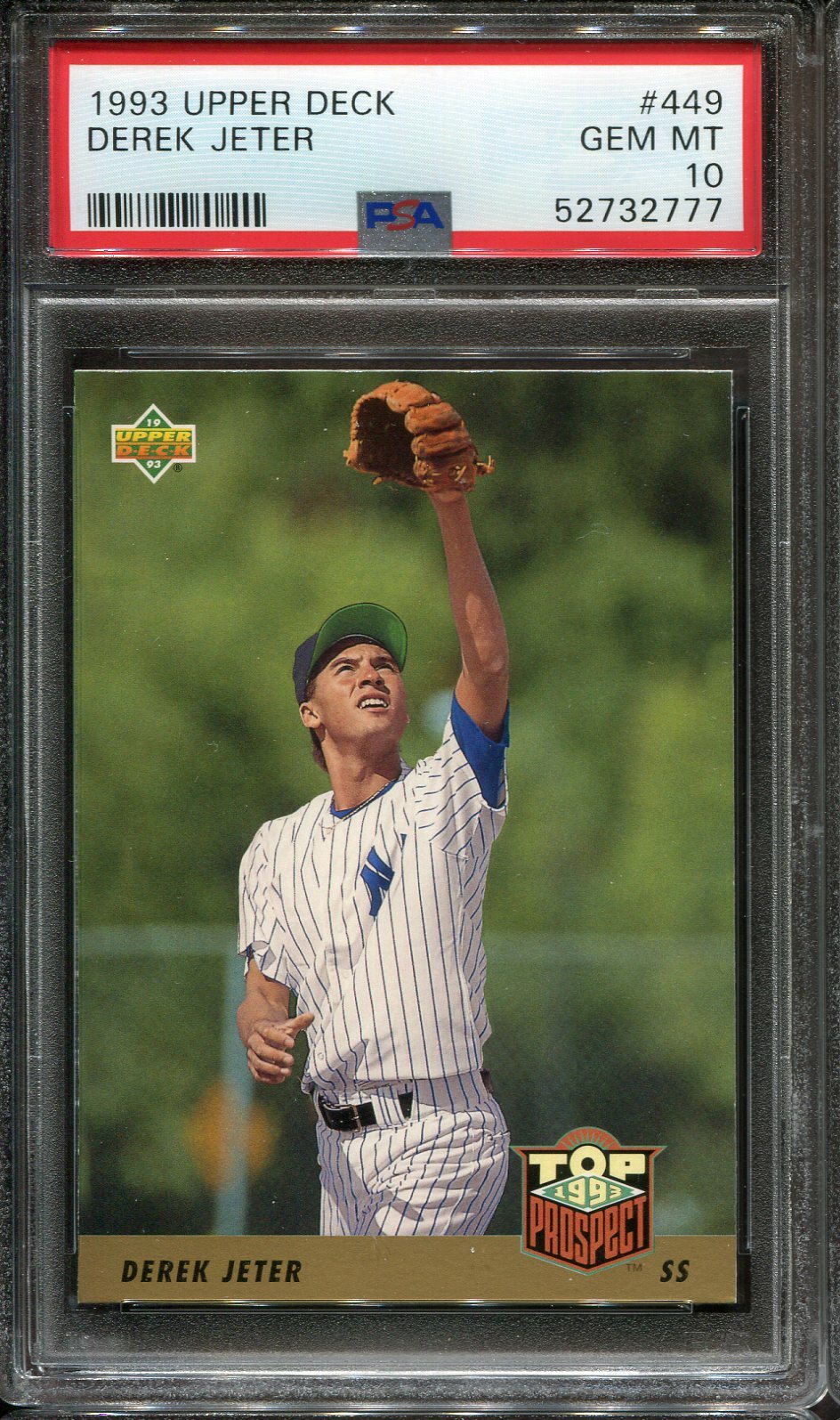
1993 Upper Deck Derek Jeter #449
Search on eBay →

Upper Deck's flagship Jeter is the second overproduced 1993 rookie on standard cardstock and the closest editorial substitute for the Topps. Cleaner design, better photography, printed in massive quantities, still cheap raw. It loses the slot to the Topps because Topps is the true flagship of the era, the brand every kid opened first, and if the museum's premise is nostalgia over rarity then the Topps is the more honest pick.